
Bilingualism
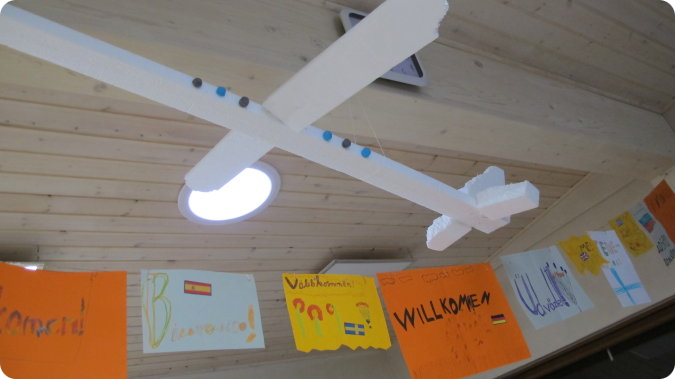
According to Kenji Hakuta, Professor of Education at Stanford University, comparing monolingual and bilingual groups of the same age in terms of mental level, social status, cognitive flexibility, or any other parameter, those of the bilingual groups are always better.
We can confidently confirm this: since 2004, Saulės Gojus has been successfully running bilingual English-Lithuanian groups, where English is taught naturally and stress-free to children from Lithuanian families, and Lithuanian to foreigners‘ children. Each group is organised according to the “one person – one language“ principle. Early second language immersion follows the same path as mother tongue immersion, so that by the time the child leaves kindergarten, he or she will have acquired the primary skills of a second language.
Children attending the German-English group also have a real exposure to Lithuanian and English, both in their own group as well as in the kindergarten premises and during common activities. In this way, the children have the perfect conditions to successfully develop their linguistic skills.
H. Gardner’s theory of multiple intelligences as the basis for a holistic education

The main feature of a professional pre-school education is the use of a comprehensive, content-rich and age-appropriate method of play. This holistic approach is probably most clearly reflected in the theory of multiple intelligences by Professor Howard Gardner of Harvard University, which is the guiding force behind our work.
Based on specific, verifiable criteria, Gardner has defined the following types of intelligence, which begin to develop at pre-school age:
Linguistic intelligence: the ability to use (native or foreign) language accurately to express one‘s thoughts and understand others. Children with this intelligence enjoy reading and writing, solving crossword puzzles, telling stories and memorising new information. Linguistic intelligence is particularly strong in poets, writers, lawyers, speakers, advertisers and journalists. By applying our bilingual educational methodology, we pay particular attention to the development of this intelligence.
Musical intelligence: special sensitivity to music, the ability to recognise, memorise and interpret musical rhythms and melodies, to understand and communicate musical symbols and patterns. Children with this intelligence love singing and rhythm. They are attentive and sensitive listeners. Representatives of this intelligence are instrument tuners, speech therapists, musicians, sound engineers and DJs. Research shows that early musical education has a profound influence on many other areas of intelligence. Saulės Gojus has teachers with extensive experience in early music education, and music(-making) are an integral part of daily life here.
Logical-mathematical intelligence: The capability for abstract thinking, the ability to evaluate chains of evidence and recognise connections between things, and the capacity to work with numbers, sets, and mathematical operations. Children with this intelligence enjoy strategy games, puzzles, and experiments. They take pleasure in mathematical exercises and tasks and are curious about the categorisation and relationships of objects and phenomena. Scientists, IT specialists, architects, accountants, and doctors tend to have high logical-mathematical intelligence. At Saulės Gojus, this type of intelligence is nurtured through specific activities, relevant didactic games, and mathematical projects designed to engage preschool-aged children.
Visual-spacial intelligence: the ability to visualise objects in the mind and perceive the surrounding environment in spatial forms. Children with this intelligence think in images, enjoy drawing, constructing, and building models, and have a strong affinity for puzzles and mazes. This type of intelligence is common among engineers, athletes, scientists, architects, and artists, among others, and should be nurtured from an early age. At Saulės Gojus, visual-spatial intelligence is fostered through puzzles, origami, art activities, and a variety of movement games, all of which serve as valuable tools for its development.
Bodily-kinaesthetic intelligence:the ability to sense and control one’s body with precision. This type of intelligence is particularly evident in athletes, actors, surgeons, and dancers. Children with strong kinaesthetic intelligence enjoy physical activities, hands-on craftsmanship, and tasks that require dexterity. At Saulės Gojus, daily physical activities and active games play a key role in developing kinaesthetic intelligence while also promoting children’s overall health.
Intrapersonal intelligence: a key component of emotional intelligence, encompassing self-awareness, the ability to recognise one’s strengths and weaknesses, emotional self-regulation, and an understanding of personal limits. Actors, writers, and artists often cultivate these qualities as part of their craft. Children with strong intrapersonal intelligence are aware of their emotions, can express them effectively, and have a clear understanding of their abilities. At Saulės Gojus, fostering a supportive environment for the positive development of each child’s personality is a fundamental priority.
Interpersonal (social) intelligence: the second key component of emotional intelligence, involving the ability to understand, connect with, and relate to others. Individuals with strong social intelligence are natural leaders, outgoing, and empathetic. This type of intelligence is commonly found in teachers, salespeople, diplomats, politicians, and therapists. At Saulės Gojus, children develop interpersonal intelligence by learning to collaborate, communicate effectively, and work as part of a group—skills that are essential for building strong social connections.
Naturalistic intelligence: an ability that involves a deep appreciation for nature and the capacity to identify, classify, and interact with elements of the environment, including animals, plants, and natural objects. Foresters, botanists, biologists, veterinarians, and environmental specialists often exhibit high naturalistic intelligence. The forests, meadows, and rural surroundings of our kindergarten in Grigaičiai provide an ideal setting for children to explore and develop this intelligence.
The educational process at Saulės Gojus is organised in such a way that all the intelligences named by Gardner are developed.